Wednesday, October 3, 2012

Youth Sport Safety: 5 Questions Every Parent Should Ask


DOES THE LEAGUE/HIGH SCHOOL HAVE AN EMERGENCY ACTION PLAN (EAP) IN PLACE?

An emergency action plan, often referred to as an EAP, is a written document that clearly delineates what steps should be followed in an emergency situation.  Specific contents of an EAP should include:  1) available personnel and their roles, 2) available equipment (AEDs, splints, spineboards, etc.), and 3) be specific to the venue and/or activity.  Additionally, the plan should be practiced regularly (minimally this is typically defined as annually) and reviewed to be sure the procedures are specific to current best practice for the care of injuries and illnesses.  For more information on the specifics of developing an EAP you can start with National Athletic Trainers’ Association Position Statement: Emergency Planning in Athletics.  While its focus is college athletics, it can be a great starting point for any organization looking to develop or update their EAP.

While many colleges are required to have an established EAP via NCAA guidelines, this may or may not be true for your school district or sports league.  Getting a copy of your school’s or league’s EAP is a great place to start in understanding the kind of care your son or daughter would receive while participating in sports should an emergency arise.  It will give you insight into the level of planning the organization has taken, what type of emergency training coaches and other staff have, who will be available and when, and what sort of equipment is available to help in an emergency. 

Some EAPs will be broader in scope and list the basic steps necessary to follow in an emergency, but others may be have several specific components that address specific injuries and situations.  Specific situations or injuries addressed may include a sudden cardiac trauma, asthma attack, heat illness, head/neck injuries and concussions.  The more specific an EAP can be, the more effective it will be should it need to be initiated.

A note on concussions:  A majority of states has enacted legislation that requires a specific concussion evaluation and treatment policy is in place.  This legislation often times also requires education of parents and key staff to recognize concussions.  Be sure when asking about the EAP that you inquire about your organization’s concussion policy.  Even if state legislation doesn't mandate a policy in your state, your organization's governing body may have a policy requirement.  

To learn whether your state has passed concussion legislation click HERE.

To review the National Federation of State High Association's position statement on concussions click HERE.

QUESTION #2:  Is there an athletic trainer available?... will be addressed in the next post.

Submitted by: Heather L. Clemons, MS, MBA, ATC

Friday, September 14, 2012

Head Games soon to be released

http://www.headgamesthefilm.com/

Thursday, July 19, 2012

Junior Seau Brain Tissue to be Studied


Per Yahoo!, Junior Seau's family has released preserved brain tissue to the National Institute of Health to be studied.

Seau, a former All-Pro NFL linebacker for the Chargers, Dolphins, and Patriots, committed suicided in his home last May. Seau's death was by far the most notable in a string of suicides from former NFL players; many of whom had been linked to multiple concussions. These concussions are believed to have played a vital role in prompting many former players to take their lives:
Seau's death echoed last year's suicide of former Chicago Bears defensive back Dave Duerson. Duerson left a note asking for his brain to be studied for signs of brain trauma. That raised anew questions about whether brain damage from repeated concussions on the field lead to long-term problems such as depression."
Although tragic, if Seau's brain tissue study shows that brain damage from concussions played a part in his suicide it could be a large leap in public awareness -- due to Seau's notoriety and popularity -- for the true dangers of concussions. However unavoidable concussions are in contact sports, such as football and lacrosse, the ability to recognize and successfully administer treatment should never go undervalued.

Thursday, July 12, 2012

Vote A4IA for a Classy Award!


Hi all, we have some great news to share with everyone! Advocates for Injured Athletes has been nominated for a CLASSY Award, which is a very big deal in the world of charitable foundations. A4IA has been selected as one of five finalists for the Health and Well Being Award at the 4th annual gathering of the awards. Please vote for us! http://www.stayclassy.org/classy-awards/vote -- After clicking on the link, click WEST, scroll down to the Health and Well Being Award, and click on Advocates for Injured Athletes.

Why is this being nominated for such an award a distinguished honor? The CLASSY Awards is the largest philanthropic awards ceremony in the entire country. Their focus is to bring recognition to the charitable achievements of nonprofit organizations, socially conscientious businesses, and individuals worldwide. CLASSY says that just last year "2,000 organizations and individuals were nominated... and their collective efforts impacted more than 200,000,000 people in more than 71 countries worldwide." Thus, this award is not limited to San Diego organizations; it spans the globe. In 2010, AOL was quoted as saying: "Hollywood has Oscar, Broadway has Tony, and now Philanthropy has the CLASSYs."

This is truly an amazing honor for Advocates for Injured Athletes. This is another avenue that we all can use to get spread the A4IA mission across the country. Thank you for all of your support and please continue to spread the word!

ALSO please vote us for the award!!! Again, here is the link: http://www.stayclassy.org/classy-awards/vote

After clicking on the link, click WEST, scroll down to the Health and Well Being Award, and click on Advocates for Injured Athletes.


Monday, July 2, 2012

Record High Temperatures Pose a Life Saving Reminder to Coaches Everywhere


The months of June, July, and August mark the peak season of summer workouts for athletes around the country. For three straight months student-athletes train their bodies to be in top physical condition for the upcoming fall season of sports. Coincidentally these three months also fall into line with the midsummer heat that Americans have come accustomed to. This past week and weekend saw temperatures reach near record highs across the Southeast. In Atlanta, temperatures on Friday and Saturday reached 105 and 103 respectively with seemingly no relief from the heat even in the early morning hours when summer conditioning workouts tend to take place.

Coaches, specifically football, preach to their teams that success on the playing field starts with a foundation of work that begins well before the game schedule commences. This foundation of work usually means hours of conditioning and weight training workouts in the morning hours Monday through Friday. The record temperatures that the Southeast has been dealing with should be a cautionary reminder to strength, conditioning, and football coaches that they need to constantly reevaluate their athlete’s workouts to fall in line with the weather and threat of heat related injuries. According to the National Athletic Trainers Association, every conditioning coach should be required to “have knowledge of health and safety issues; certified in first aid, resuscitation and heart defibrillation; know which athletes have sickle cell trait; and know how to recognize signs and treat exercise-related complications from the condition. And they should be present during all condition sessions." 

However, the onus of injury should not simply be placed on the coaches; the student-athletes themselves need to be educated on the warning signs that can lead to injury and even death from the heat. If one is feeling light headed, dizzy, or over heated there should be no shame in speaking up and taking a break from an exhaustive workout. Less than one year ago, two high school athletes from Georgia died within hours of each other due to heat exhaustion and heat stroke. One of the athletes, 17-year old Forrest Jones of Locust Grove High School, died at a voluntary team workout in preparation for the upcoming football season. His family was quoted as saying: “his determination may have cost him his life,” and had a message for other student-athletes: “If you feel like you're tired or thirsty, tell your coach you gotta take a break, you gotta sit down… When you think it can’t happen to you or your family, it really can.” Without proper education for coaches and athletes alike, devastating tragedies like this are always a real threat. Due to the threat of heat related injuries, the Georgia High School Organization does not allow mandatory team workouts until after August 1. However, that does not stop coaches from holding voluntary workouts that athletes can attend. In short, the safety of student-athletes should be paramount in the minds of coaches around the country, specifically when dangerous temperatures loom.

For sources and further reading on the threat of heat related injuries see:


Monday, June 25, 2012

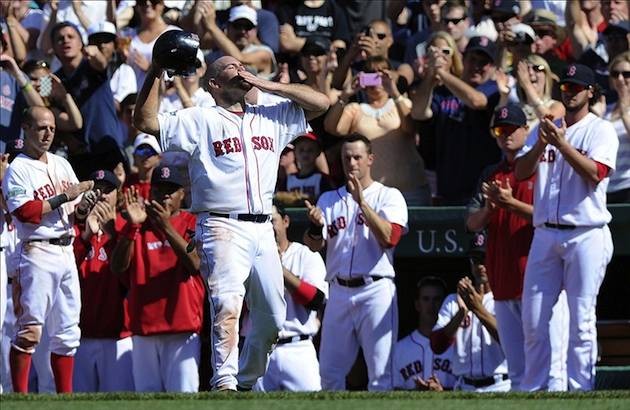
Farewell, Kevin Youkilis


Note: Here is a post from a sports blog that myself and my two younger brothers run called When Larry Met Magic. The post is about Kevin Youkilis and his departure from the Red Sox yesterday. I thought it was relevant to A4IA because Youkilis was and is the type of player that any coach would love to have and that any player should try to emulate on a day-to-day basis.


Although necessary, the departure of Kevin Youkilis from his home in Boston is certain to take an emotional toll on Red Sox Nation. A baseball player that all should emulate for his “Dirt Dog”-leave-it-all-out-there-go-hard attitude, Youuuuukkkkk surely has had one of the most storied and successful careers of anyone to don a Sox uniform.

He began his ride with the Red Sox back in 2004 and (kind of) helped vanquish the ghosts of 1918 and the Great Bambino. He was around for the Red Sox second Sox World Series title of the century in 2007, one in which he played a more prominent roll for the World Champs. The following three years (2008-2010) will be regarded as Youk’s best when he hit .308/.404/.560 with 75 home runs. 2010 was a different story, however, when injuries took their toll on the “Greek God of Walks,” as Billy Beane nicknamed Youk back in his college days, and Youkilis mustered only a .258 average with 17 home runs. 2012 will more of less become a story of the emergence of rookie sensation Will Middlebrooks rather than the continued decline of Youk. The contrast between the two could not have been more black and white: “Middlebrooks, it was noted by the Elias Sports Bureau, had put up numbers in his first 40 games -- .331 average, 9 home runs, 33 RBIs -- last accomplished, among players in their first 40, by one Albert Pujols.” Simply, it was only a matter of time before the third base torch was passed to the kid – yet, it happened well ahead of Youkilis’s schedule.

Time will tell if Youk’s steady decline as a Red Sox hitter was due to an accumulation of injuries, advanced age, or simply putting too much pressure on himself. Nevertheless, that should not matter. Like all others of Red Sox lore who have come and gone, leaving with them an undeniably extraordinary mark on Boston Red Sox history and the Green Monster, Kevin Youkilis should not be remembered for his lesser statistics over the past year and a half. Rather, he should be celebrated for his triumphs in a Boston uniform: two-time world champion, two top-ten MVP finishes, a gold glove, 3 All-Star game appearances, and countless more unforgettable moments. I can vividly remember the New York Yankees repeatedly throwing at Youkilis out of hatred, but more out of respect. Rick Porcello of the Detroit Tigers will certainly never forget when, after a bean ball, Youk broke out into a full sprint towards Porcello, hurled his helmet at him, and attempted a takedown. “Take every at bat as if it was your last,” is something that coaches consistently harp on to their players. Teammates, coaches, and fans alike know that Kevin Youkilis took that saying to another level. A fan of professional baseball can’t ask for anything more than that.  

There should be no “smear campaign” for Youk as we saw with Nomar, Mo Vaughn, and Terry Francona. No, Youk’s career in Boston did not end harmoniously, but there is no need to sweep under the rug all his accomplishments. A simple thank you and a tip of the cap in acknowledgement is all Youk would want from Red Sox Nation.

The Red Sox organization will move have moved on as quickly as the time it took Youkilis swiftly hustle out of Fenway Park in the seventh inning of yesterday’s game in Boston during a heartfelt farewell standing ovation. Don’t let him fade away that quickly, Red Sox Nation; he doesn’t deserve to. Here’s to one of the last “Dirt Dogs,” Kevin Youkilis. Thank you. 


Scroll to 2:30 for Youkilis's imitation... Comedic gold. 

Feel free to check out the blog When Larry Met Magic if you are a fan of sports and humor.

Friday, June 22, 2012

The True Values of Athletics

Hello Advocates for Injured Athletes readers. My name is Joe Reilly and thanks to my Aunt and founder of A4IA, Beth Mallon, I have recently decided to begin blogging for A4IA.

Athletics has always been a foundation in my life. From a very young age I was hooked on participating in, watching, and discussing sports – part of this is due to the fact that I grew up with two younger brothers to whom I never wanted to lose (similar to the Mallon boys). Baseball was the sport I was drawn to and I was blessed to be able to compete until I graduated from college in May of 2011 from Sewanee: The University of the South in Tennessee. Although I no longer am able to participate I have found an antidote that is nearly as fulfilling: coaching. After graduating college I accepted a position at the Wesleyan School in Norcross, GA as a Middle School history teacher, and cross country and baseball coach.

Life as a coach is much more than statistics. It is certainly much more than wins and losses, which is something that many coaches lose sight of from time to time. Coaches have the rare opportunity to be a leader, coach, and teacher at the same time. Yes, a coach needs to help his or her athletes improve their physical abilities. Yes, a coach needs to strive for success on the field of play. These are both valid goals of a coach that are included in many job descriptions. However, the true goal of every coach should be something that is not explicitly stated in the job description: the teaching of life lessons. Being able to impart the qualities and values of honor, integrity, humility, courage, grace, and resilience upon your athletes is of the utmost importance as a coach regardless of the level. As an athlete failure is inevitable. How an athlete reacts to this failure is a way in which a coach can measure success. If athletes can make the above qualities a part of their everyday lives on and off the field then a coach has achieved perfection.

Advocates for Injured Athletes mission, values, and goals fall directly in line with this. Our mission states: “To promote sports safety and to provide essential support, education, and resources to help keep athletes safe.” Thus, if that means risking success in the win column by removing an injured player from the field of competition then so be it. “Win with humility and lose with grace,” is the common quote many coaches ingrain into their athletes heads. In order to truly fulfill this quote both coaches and athletes alike must have the ability to make safety and the promotion of life lessons the true goal in athletics. A young man or woman’s general health is more important than one run, one touchdown, one basket, or one win. Thus, the education of safety also becomes a life lesson for all. If maintaining the safety of one’s players’ means losing, then coaches and athletes alike should be able to end the game with their heads held high and know that they stuck to the true values of athletic competition.